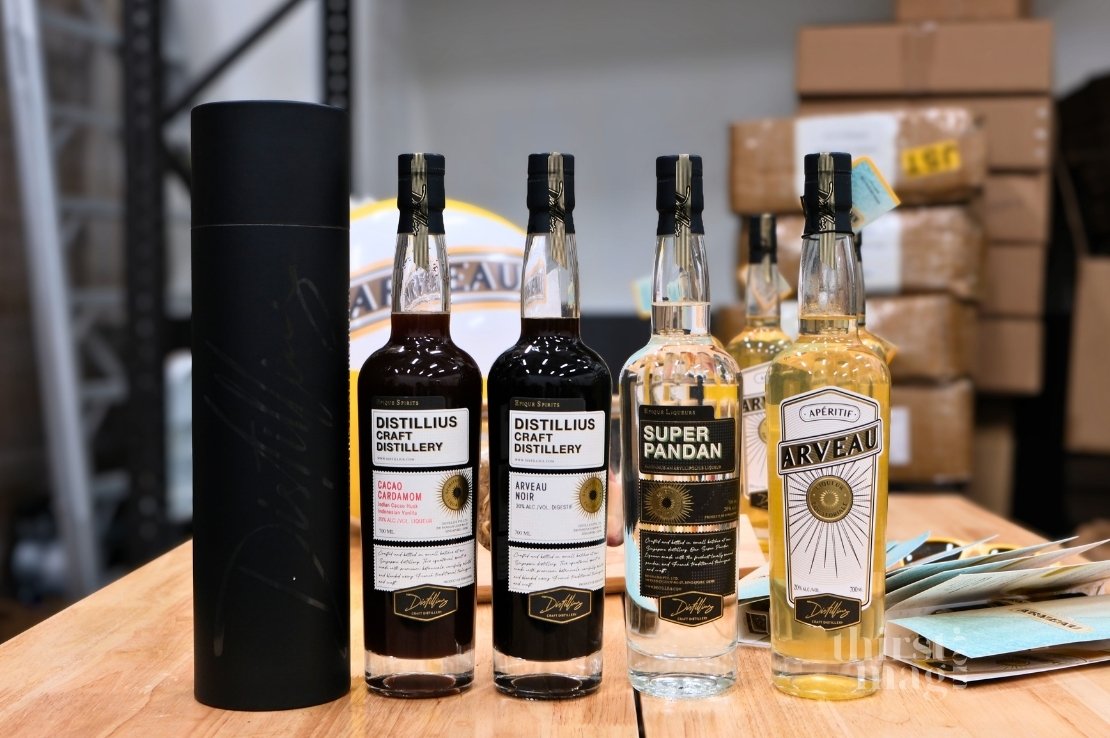
In a hot and humid city, a low-ABV and refreshing spritz feels like an obvious drinking choice. Yet while Singapore’s distilling industry has embraced gin and whisky, aperitifs and liqueurs remain relatively unexplored, which makes a surprising gap for consumers living in the tropics.
Distillius, a compact distillery tucked within one of Singapore’s multi-storey industrial estates, is positioning itself as one of the region’s few producers focused on aperitifs and flavour-driven liqueurs. Its ambition is to translate Southeast Asian flavours into spirits designed for modern drinking, while filling a category that has long been a void in the local market.
The origins of Distillius trace back to a collaboration between hospitality professionals Edward Lee (Business Director) and Peter Teo (Creative Director). Their partnership began while launching a gin for PS.Cafe, where Philibert Gandy (Head Distiller) was involved during his time at Tanglin Distillery. Jay Gray later joined the company as Brand Manager, and Lua Ker Han as the Operation Manager.
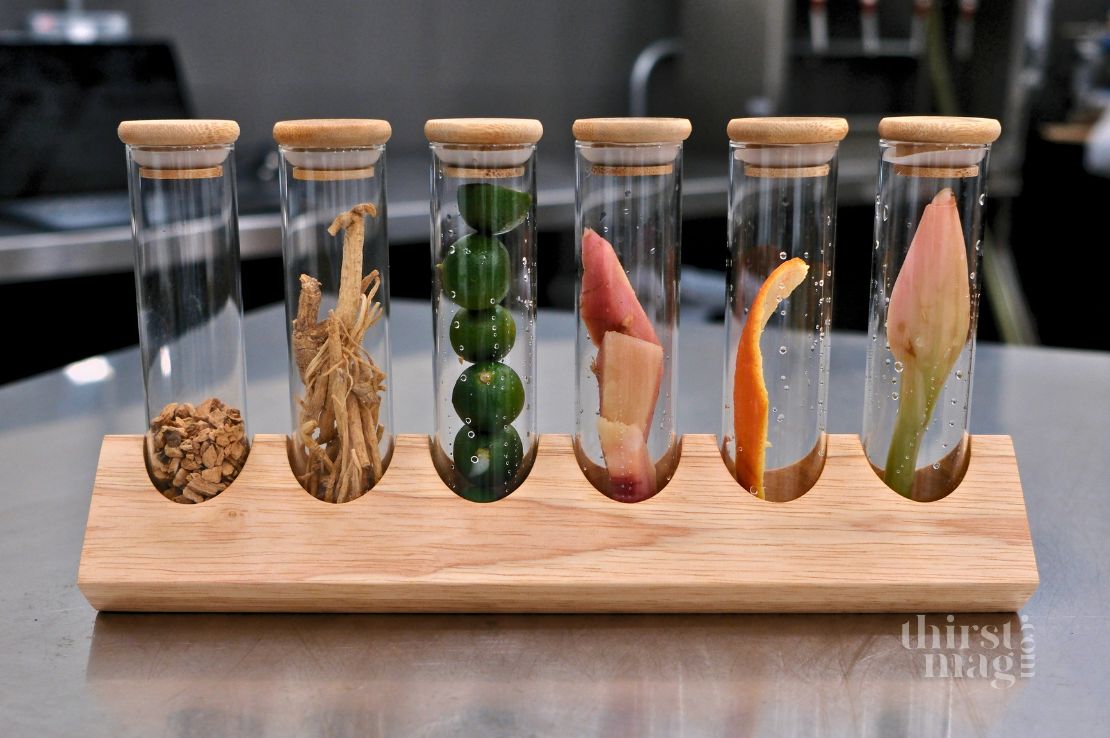
Ingredients used in Arveau: gentian roots, ginseng, calamansi, galangal (blue ginger), mandarin and torch ginger. [Photo: Kim Choong]
Entering the facility behind two fans of shutters exposes a custom-made still that fits the compact size distillery. In a sense, it looks more like a laboratory of flavour, which is what it is set to do when Philibert Gandy was brought in to do the job. The distillery’s identity is clear, the production philosophy sits between European distilling tradition and Southeast Asian flavour exploration.
Stepping through the shutters into the production facility reveals a custom-built still designed to fit the compact distillery. The space feels less like a factory and more like a laboratory of flavour, which is what Philibert was brought in to do. His experience in European distilling traditions is the production philosophy that goes alongside Southeast Asian flavour exploration.
“This is where the magic happens,” says Philibert, as he gestures toward the equipment.
When deciding what to produce, it was obvious that gin had already become a crowded territory in Singapore whereas liqueurs remained largely unexplored. That realisation pushed Distillius toward developing flavour-driven spirits inspired by regional ingredients.
The research and development phase alone took around 18 months, overlapping with the lengthy process of licensing a distillery capable of storing high-proof ethanol in Singapore.
Today, the facility can produce roughly 50,000 bottles annually, with the potential to scale to 100,000–150,000 bottles if automation is introduced. For now, most of the work remains manual: from sorting the ingredients to blending and from bottling to labelling, a deliberate decision aiming to preserve the artisanal character of the spirits.
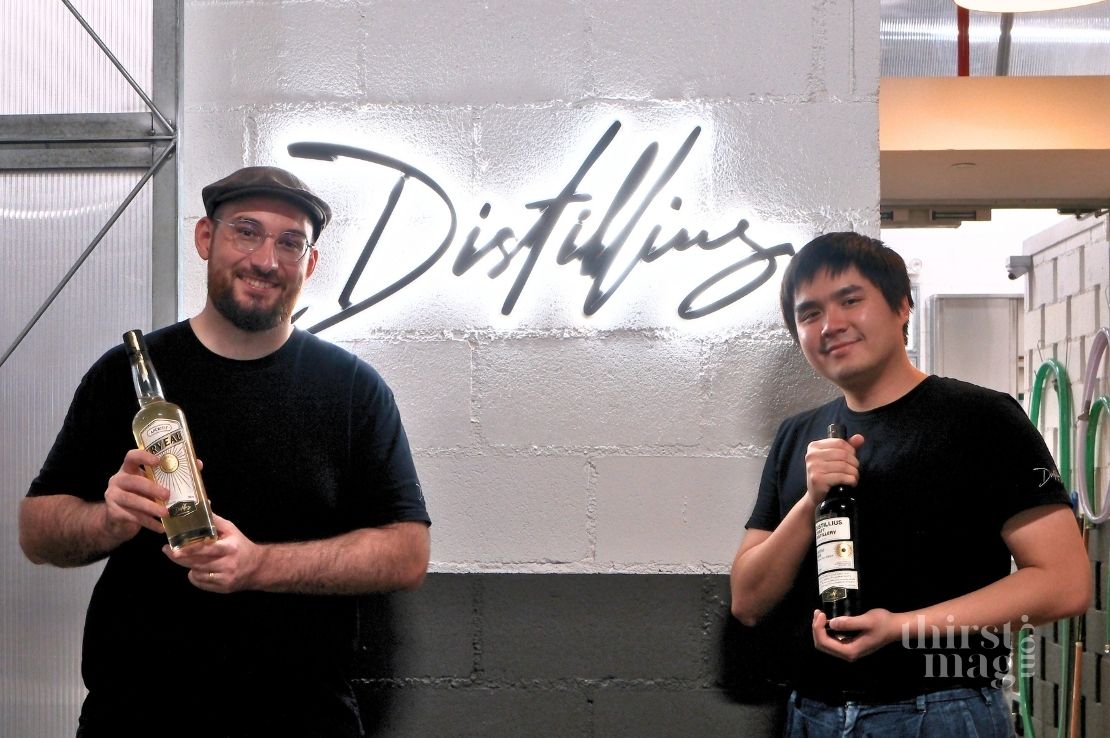
Head Distiller Philibert Gandy and Operation Manager Lua Ker Hian outside the ditillery. [Photo: Kim Choong]
Arveau - A Spritz for the Equator
Distillius’ first product and the flagship is Arveau, an aperitif developed with Singapore’s climate and drinking culture in mind.
The idea came from observing café culture and casual dining spaces, where spritzes consistently outsold heavier cocktails because they were easy to drink at any time of day. “You can have a spritz early lunch, or later in the day. It’s not too much commitment,” Philibert explains.
Arveau begins with a neutral grain spirit sourced from Australia, chosen as a clean base that allows the botanicals to shine.
The recipe combines torch ginger, calamansi, galangal (blue ginger) and mandarin, all distilled in small copper stills before being macerated with ginseng and gentian roots to create the aperitif’s bittersweet backbone.
The resulting spirit carries floral ginger-like notes, while calamansi brings a bright citrus lift. Galangal introduces grassy freshness balanced by the candy-like sweetness of mandarin peel, while ginseng leaves an earthy herbal tone lingering beneath the aroma.
Served as a spritz, the drink lands at roughly 5% ABV, making it light and refreshing. “It’s something you can have one or two of without getting fully boozed up,” Philibert says. In many ways, Arveau feels designed specifically for Singapore’s perpetual heat and a modern drinking culture increasingly leaning toward moderation.
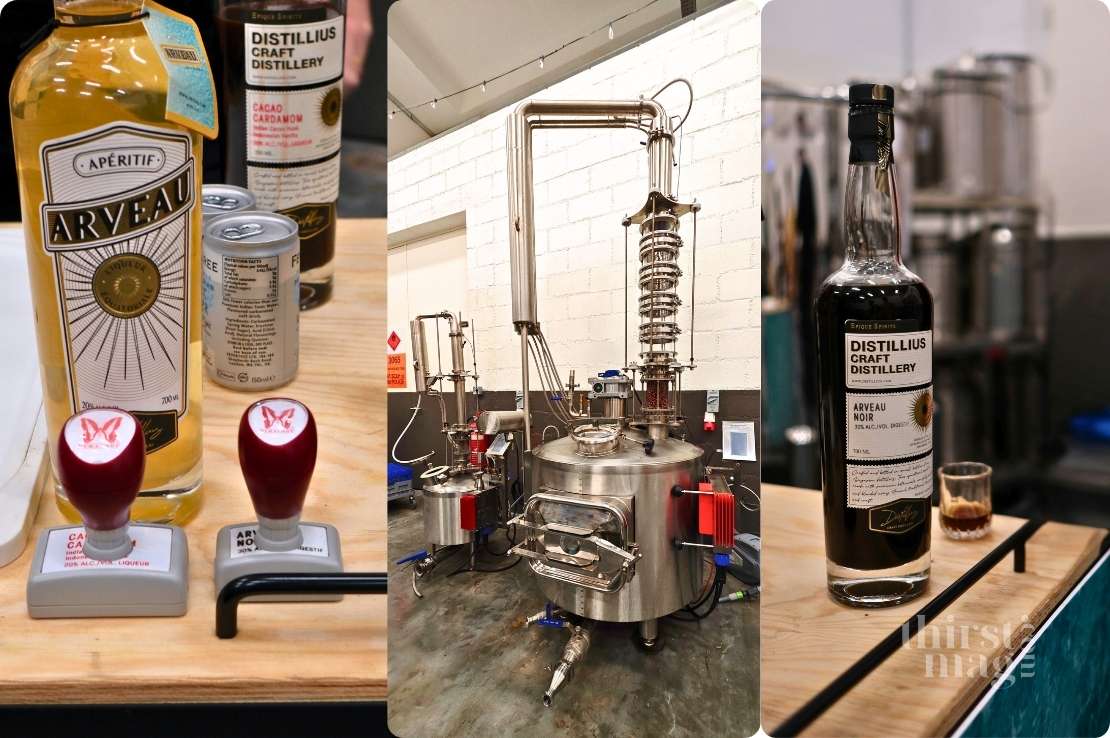
From left: Distillius still bottles and labels manually, with individual stamp; A new generation custom-made double jacket German still is the sole spirit production in Distillius, accompanied by a centrifuge; Arveau Noir. [Photos: Kim Choong]
Official recipes for Arveau
Arveau Pineapple Spritz
1 Part Arveau
2 Parts Soda
2 Squeezed Lemon Wedges
3 Pineapple Chunks
Arveau’s White Rosita
1 Part Arveau
1 Part London Dry Gin
1 Part Dry Vermouth
Lemon Zest
Arveau G&T
1 Part Arveau
1 Part Dry White Wine
1 Part Gin
2 Parts Indian Tonic Water
2 Squeezed Lemon Wedges
Super Pandan – A Rewarding Challenge
If Arveau represents the distillery’s aperitif philosophy, Super Pandan showcases its approach to regional ingredients.
Pandan is widely used in Southeast Asian cuisine, but translating it into a spirit is more complicated than it seems. The aroma fades quickly once the leaves are cut, and the flavour can easily become overpowering during extraction.
Through repeated experimentation, the team discovered freshness was the defining factor.
“If pandan sits overnight in the fridge, the aroma changes when you distil it,” Philibert explains.
To preserve its fragrance, Distillius sources fresh local pandan, sometimes processing as much as six kilograms per batch.
The resulting liqueur captures pandan in a restrained and natural form. Instead of the artificial sweetness often associated with pandan syrups, Super Pandan delivers soft grassy aromatics, gentle sweetness and a creamy finish.
The liqueur has already won a gold medal at a spirits competition. In the bars, the liqueur has begun appearing in cocktails such as Pandan Coladas and Pandan Old Fashioned.
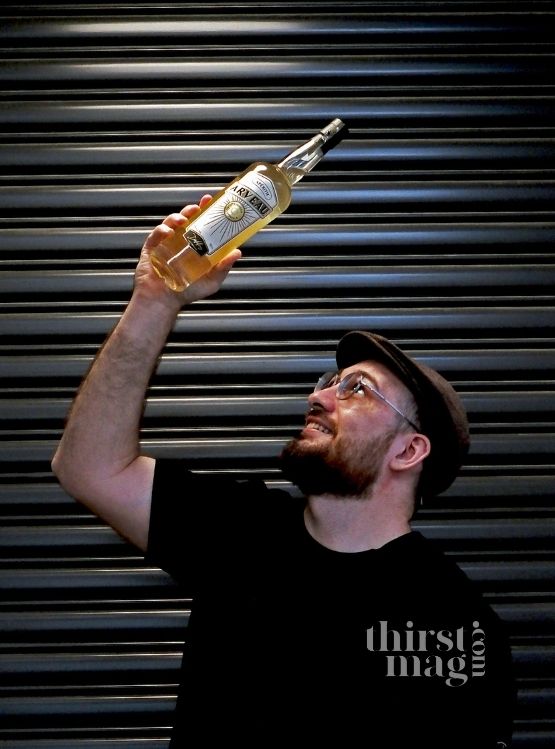
Philibert Gandy, Head Distiller at Distillius grew up having multiple home made aperitifs as staples in their french household. [Photo: Kim Choong]
Arveau Noir - The After-Dinner Counterpart
While Arveau is meant to start a meal, Arveau Noir takes the role of a digestif.
The inspiration comes from Philibert’s fascination with liqueurs traced back to his upbringing in Grenoble in the French Alps, a region closely associated with the Carthusian monks behind Chartreuse.
Growing up surrounded by Alpine herbal spirits, Philibert jokes that his family always kept at least three bottles of Chartreuse at home, shaping his early obsession with herbal liqueurs and digestifs. That influence now finds its way into Arveau Noir, where classic European amaro and Alpine liqueur traditions are reinterpreted through Asian botanicals. Many of the ingredients are sourced from traditional Chinese medicinal shops, including mugwort (from the Artemisia family), Chinese rhubarb root and pomelo peel.
Mugwort brings a grassy bitterness similar to wormwood, while Chinese rhubarb contributes the liqueur’s deep orange-brown colour and earthy body. Pomelo peel sourced from Ipoh adds citrus bitterness that brightens the otherwise dense herbal profile.
The flavour is bold and bittersweet, with a long herbal finish that works particularly well in darker cocktails such as Negronis. Served neat, it functions much like traditional Alpine herbal liqueurs that is strong, aromatic and intended to settle the stomach after a heavy meal.
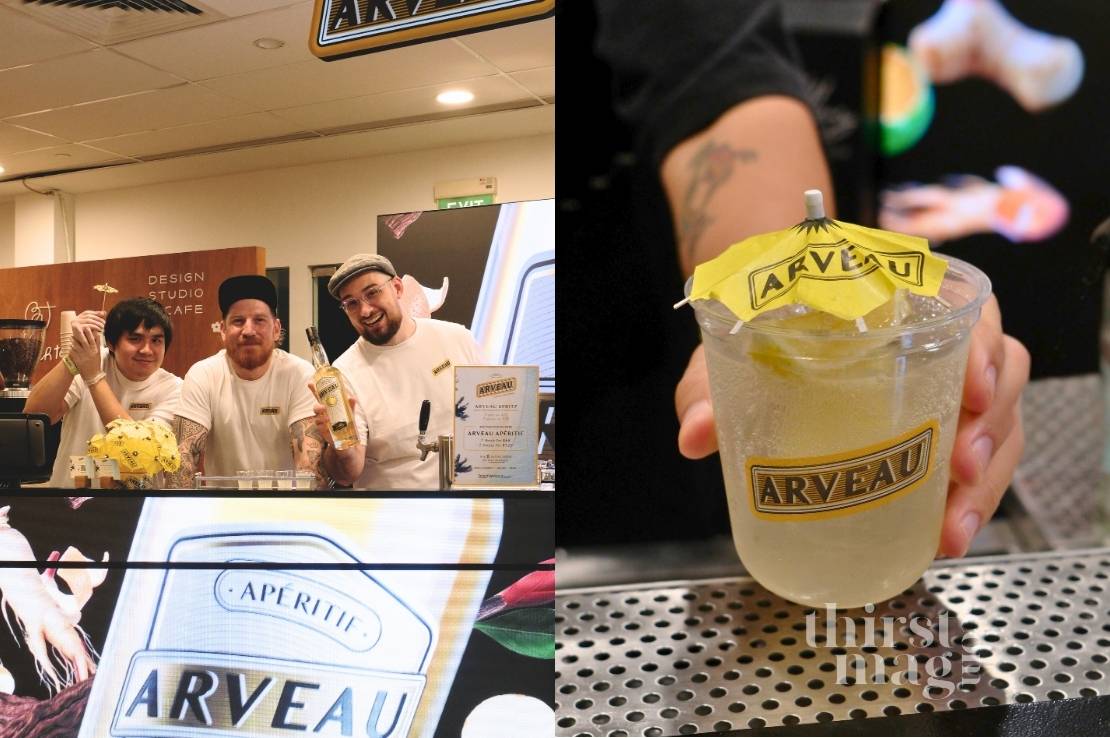
Distilius team at the Boutiques Fair 2026: (From left) Lua Ker Hian, Jay Gay and Philibert Gandy; (Right) Arveau Pineapple Spritz. [Photo: Kim Choong]
Experiments in the Distillery
One of the advantages of running a small distillery is the freedom to experiment. Distillius frequently develops prototype liqueurs that may never reach commercial release. Among the more unusual trials are durian and coriander liqueurs, both still undergoing experimentation.
Not every experiment makes it to market. The team uses what they call the “second drink test”, a philosophy borrowed directly from hospitality. If a spirit feels exciting but nobody wants another glass, it stays as a prototype and doesn’t get commercially released.
Making the liquid, Philibert says, is only half the work. The real challenge is turning that liquid into something people genuinely want to drink again.
Distillius is still young but its ambitions stretch beyond Singapore. The brand currently distributes locally while exploring regional markets and travel retail opportunities.
- T -