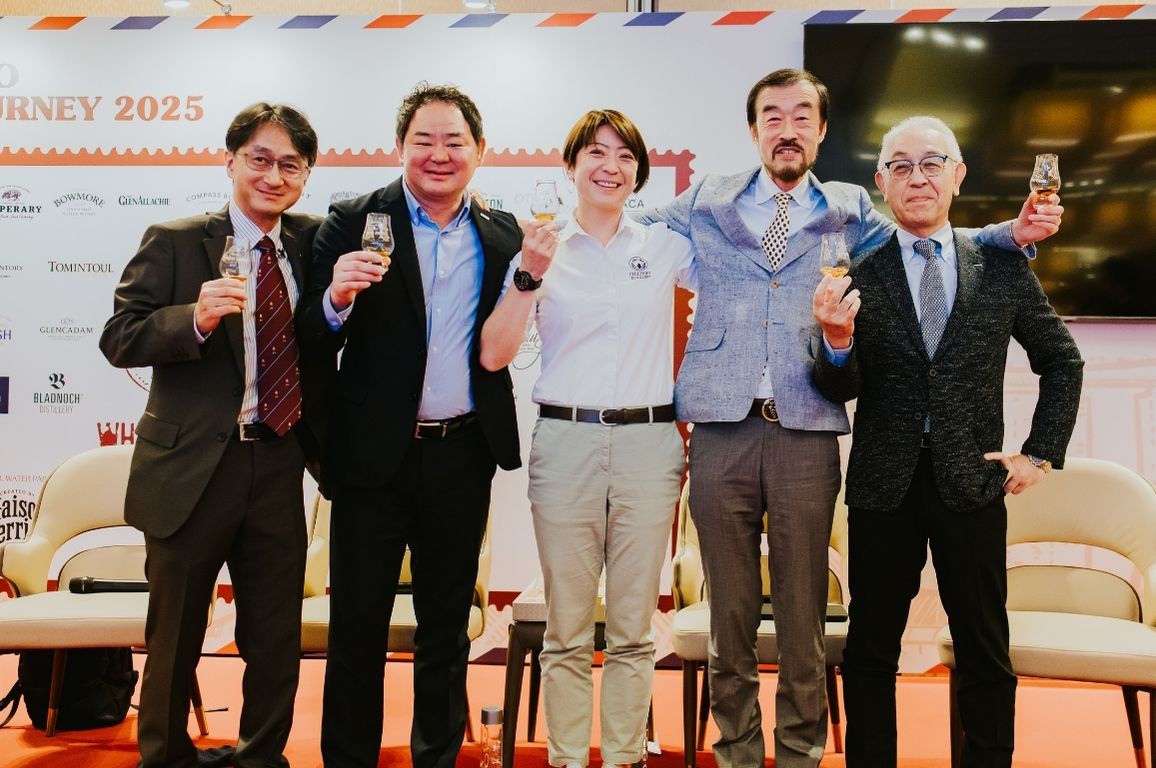
While much of the global whisky industry is navigating the market with caution, Japanese whisky has arrived at a defining juncture, where producers are choosing to collaborate in charting a new frontier. At Whisky Journey 2025, held in Marina Bay Sands Expo in November, five of Japan’s most respected whisky icons came together for a rare and historic panel discussion on the category’s future.
Moderated by host Alan Wu, the conversation brought together (by seating sequence) Shinji Fukuyo, Chief Blender of The House of Suntory; Jota Tanaka, Master Blender at Kirin Brewery; Yumi Yoshikawa, Global Brand Ambassador of Chichibu; Hiromi Ozaki, Senior Blender at Nikka Whisky; and Yoshitsugu Komasa, Founder, CEO and Master Blender of Kanosuke Distillery.
It was the first time all five appeared together in Singapore, offering an unprecedented glimpse into the philosophies, pressures and aspirations shaping Japanese whisky in the decade ahead.
Defining and Evolving Japanese Flavour
Japanese whisky does not exist as a single category with a single taste. Instead, as the panellists emphasised, its character lies in a spectrum of nuance shaped by climate, water, fermentation, wood and the maker’s philosophy.
Suntory’s elegant signature, heightened by soft water and dramatic seasonal shifts, has been refined for more than a century. Kirin, meanwhile, sees its identity in clarity, floral, elevated, and inspired by the natural beauty of Mount Fuji.
“Suntory style, I can say subtle, refined, yet complex.” – Shinji Fukuyo
Even within single malts, Japanese distilleries produce multiple styles internally and then blend them to create complexity. This approach, the panel noted, allows each house style to remain recognisable while continuously evolving.
“Our style is clean and estery… purity, transparency, nothing uncluttered.” – Jota Tanaka
For Kanosuke, whisky innovation is inseparable from its shochu heritage. Their use of ex-shochu casks and three differently designed pot stills creates textures and flavours unique to southern Japan’s tropical, seaside climate.
“Our whisky has a very unique DNA. Our background is 140 years of shochu.” – Yoshitsugu Komasa
Nikka echoed this emphasis on technique-driven exploration, sharing how small changes in raw materials or fermentation lead to dramatic flavour shifts. Both distilleries grounded their experimentation not in novelty, but in respect for the craft and the desire to create something authentic to their region.
“By changing the yeast, the fermentation period, we can achieve apricot or peach-like flavours.” – Hiromi Ozaki
Innovation, however, is also a practical necessity. Because Japanese makers rarely exchange casks, each distillery must independently build breadth in their whisky styles to satisfy both domestic and global palates.
The Push for Transparency and Integrity
“We were very concerned… many bottles overseas are labelled Japanese whisky, but they are ambiguous, some are not whisky at all.” – Jota Tanaka
The panel did not shy away from addressing the elephant in the room: misleading “Japanese whisky” on international shelves. Many bottles marketed as Japanese may contain imported liquid or products that technically are not whisky at all.
This erosion of trust pushed the industry to act. Through the Japan Spirits & Liqueur Makers Association, a new set of standards and a new consumer-facing mark aims to clearly define Japanese whisky and protect its integrity. Both Jota and Yumi stressed that this is not about superiority, but about honesty, clarity and respect for the consumer.
“When labelled as Japanese whisky, it means where the whisky is from. There is so much information and transparency has to come to your glass.” – Yumi Yoshikawa
Jota agreed with Yumi and added that he didn't believe Japanese whisky are better than others but they want to protect the integrity and sincerity built in the industry.
Integrity, the panel emphasised, also sits at the heart of Japanese whisky’s unwritten code. In Japan, distilleries do not swap whiskies, not out of competition, but out of principle. The makers are not rivals; they speak openly, share knowledge and learn from one another. Yet each distillery believes in creating its own character from the ground up. Rather than exchanging liquid, the focus is on developing a distinct house style, shaped by craftsmanship, its environment and believes.
Pricing, Market Pressure and Category Protection
Japanese whisky’s skyrocketing prices drew a candid, balanced response. While some consumers see current prices as justified, others find them inflated, especially when hype drives demand faster than quality can mature.
“If the price is here (holding her palm to eye level), we have to reach here with the quality.” – Yumi Yoshikawa
Producers feel a responsibility to ensure that craftsmanship keeps pace with cost. Young distilleries entering the market at premium price points complicate the landscape, but the consensus was that sustainable growth will ultimately filter the market naturally.
“The secondary market is abnormally high.” – Jota Tanaka
Competition, the producers reminded the audience, should never come at the expense of trust. Protecting Japanese whisky’s reputation requires collective vigilance from everyone in the industry.
Kaizen, Monozukuri and the Japanese Mindset
Kaizen and monozukuri (continuous improvement and deep craftsmanship) are often associated with Japanese industry. The panellists explained that these values are not corporate slogans, but instincts embedded in everyday work.
“One of the characteristics of Japanese whisky is delicacy. It’s difficult to explain, but people around the world can sense it in how we make and blend our whisky.” – Hiromi Ozaki
“Kaizen enhances quality… and craftsmanship in detail is our weapon.” – Shinji Fukuyo
Whether refining fermentation, rethinking cask policy or adjusting blends, the search for improvement is constant. It is a quiet discipline (built in their blood), they said, and one that maintains Japanese whisky’s global reputation for precision and quality.
“Always looking for room for improvement… it’s like (our) second nature.” – Jota Tanaka
Greater Diversity Ahead
From the cold forests of Hokkaido to the subtropical shores of Kagoshima, Japan’s environmental diversity is increasingly evident in its whisky. Makers are exploring yeasts, fermentation lengths, still shapes, climates and casks, not doing it to chase trends, but to inspire both themselves and the drinkers.
“By making whisky in tropical Kagoshima, we are contributing to diversity in Japanese whisky industry.” – Yoshitsugu Komasa
Several panellists noted that diversity is not a goal by itself. A unique whisky should still taste delicious. As Shinji observed, innovation must be rooted in flavour and not just being different.
“Diversity is naturally happening because each of us has different character.” – Yumi Yoshikawa
Growth is Inevitable, Quality is Choice
As more countries enter the whisky-making arena, the panel agreed that sheer numbers mean very little without substance. Growth only matters if producers can meet and sustain consumer’s expectations. Japanese whisky should not be judged by how many distilleries exist, but by how many are genuinely good. If Japan is home to a hundred distilleries making whisky with integrity and intent, that strengthens the industry’s image.
“The number of distilleries doesn’t matter. What matters is whether producers can meet consumers’ expectations.” – Yumi Yoshikawa
“Japanese whisky is not one style. What makes it distinctive is integrity and a focus on the people who drink it.” – Jota Tanaka
With as many as 200 distilleries now operating or in development across Japan, the panel viewed this moment as a natural phase of industry evolution that will eventually stabilise as weaker players fall away and the category matures.
What the World Can Learn from Japan
Japanese whisky earned its reputation through quality validated in blind tastings and not storytelling alone, referring to awards earned throughout the years. The panel emphasised that global whisky makers can take inspiration from Japan’s flexibility, its openness to world blending, and its insistence on sincerity and craft.
“Please focus on the quality.” – Shinji Fukuyo
The lesson, they suggested, is not about replicating Japanese whisky, but about embodying its approach: humility, curiosity, and a relentless pursuit of improvement.
“Look outward… learn from each other no matter who you are.” – Jota Tanaka
Looking Ten Years Ahead
Asked to imagine Japanese whisky in a decade, the panel responded with optimism. Hiromi spoke of moving toward Nikka’s 100th anniversary with renewed emphasis on joy and craft; Kanosuke focused on growth through learning; and Yumi projected the future as a product of the choices the industry makes today; while Shinji lightened the mood by joking about retirement that briefly softened an otherwise serious conversation.
“In ten years, I hope Japanese whisky companies continue working together, not individually, to raise the category as a whole.” – Hiromi Ozaki
“Our distillery is under 10 years but we have made shochu over 140 years. I hope that by learning, from each other, the Japanese whisky industry will grow in a healthy way.” – Yoshitsugu Komasa
“Those who make whisky with sincerity will last. The next stage for Japanese whisky comes through integrity, transparency, and working together.” – Jota Tanaka
“We want to elevate joy through the diversity of our whiskies.” – Shinji Fukuyo
Japanese whisky may be young on the world stage, but its trajectory is defined by integrity, innovation and an unwavering commitment to quality. If the energy (and humbleness) of this panel was any indication, the next decade stands to be a very interesting chapter yet.
“We are making our future, not someone else.” – Yumi Yoshikawa
- T -