At a time when Asia’s wine and spirits sector is being reshaped by inflationary pressures, shipping obstacles and tariffs, shifting consumer behaviour, and evolving drinking cultures, ProWine Singapore presented the first World Business Report for the Southeast Asia market. A panel of industry experts have been invited to confront a crucial question: Where is Southeast Asia wine and spirits market really heading?
The report prepared by Prof. Dr. Simone Loose of Hochschule Geisenheim University, Department of Wine and Beverage Business Research paints a broadly optimistic picture of the wine and spirits market, supported by expectations of growth, rising curiosity among consumers, strong confidence in premiumisation and emerging categories. Yet, when these findings were put under the microscope during the panel discussion, the conversation shifted from optimism to on ground practical realism. The report was reframed with translating the data into cultural context, market structure, and trade’s experience.
Moderated by Spirited Asia co-founder Aaron Kong, the session brought four authoritative voices to the panel, each representing a different vantage point of the trade. They included Nimmi Malhotra, a veteran drinks journalist and judge; Gerald Lu, President of the Sommelier Association of Singapore; Tan Ying Hsien, Singapore’s first Master of Wine; and Lam Chi Mun, a spirits educator shaping bartending capability across the region for the past three decades.
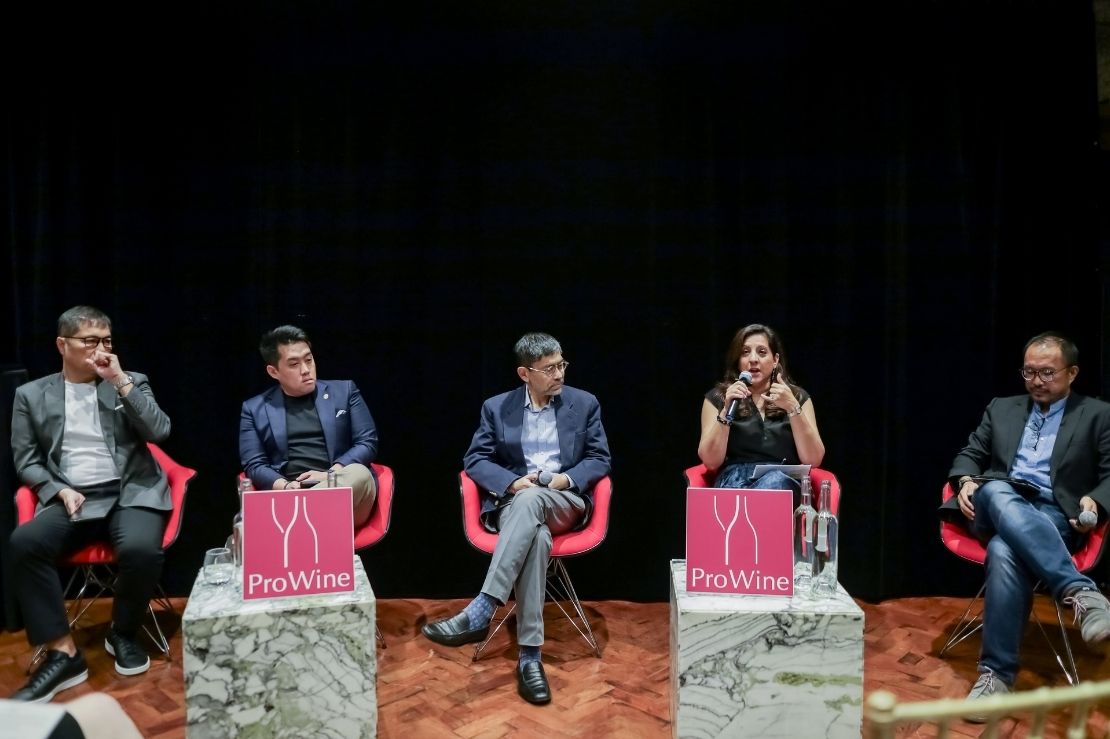 From left: Lim Chi Mun, Gerald Lu, Tan Ying Hsien, Nimmi Malhotra and Aaron Kong. [Photo source: ProWine]
Here are the five key discussion headlines deriving from what the report says and the panel’s view.
1. Market Conditions vs Market Reality
ProWine World Business Report Singapore:
Singapore’s wine and spirits market remains resilient and cautiously optimistic, despite ongoing economic and cost pressures. According to the report, 36% of trade experts rate their current business situation as good or very good, while 63% expect their company’s economic situation to improve over the next three years. This confidence is mirrored by international producers, with 77% anticipating growth by 2028.
Aaron:
Is the market as hopeful as the report suggests?
“I don’t think we see that kind of optimism on the ground,” said Nimmi, who shared that she had spoken directly to 12 distributors to gauge sentiment beyond the survey data. “The trade here is cautiously optimistic because everyone has had a tough year. The F&B ecosystem is dealing with higher costs, and people are becoming more selective about what they buy.”
She drew a clear distinction between two types of producers operating in the region. “There are producers who understand Southeast Asia, they have feet on the ground, they invest time, and they work closely with local trade partners and distributors to understand how varied the market really is,” she said. “Then there are those who still think Southeast Asia is monolithic. They forget there are 11 countries with very different nuances. That said, the market welcomes them too because they bring optimism with them, and sometimes that optimism lifts the trade.”
Ying reinforced this view, noting that the survey sentiment felt more like hope than conviction. “Many businesses have had a very tough 18 to 24 months,” he said. “Inflation, tariffs, and logistics costs are still very much top of mind, especially in Asia where you need a cold chain. Middle-class consumers are holding back more than before even if the ultra-premium drinkers still have money, they’re cautious.”
He pointed to pricing corrections in Champagne as a signal of broader uncertainty. “Why put money in now when you can see big Champagne houses beginning to lower prices because demand has dropped?”
Ying also framed the issue within a broader cultural and historical context. “Asia is very different from Europe,” he explained. “Historically, wine in Europe was an everyday beverage, fresh wine meant to be drunk within the year, not aged for ten years. That culture is disappearing, and Europe has seen the deepest plunge in per-capita wine consumption. Wine consumption is picking up in China and parts of Asia, but will it make up that slack? Unlikely. Here, wine is still largely a show-of-status product among the wealthy. For the middle class, it remains a party or special-occasion drink, not a daily one.”
The reality, the panel agreed, is that optimism is not evenly distributed. For producers with deep roots in Southeast Asia, confidence is measured; for others, it may reflect assumption more than insight. It is also noted that optimism in surveys can reflect psychological need for reassurance rather than economic certainty.
2. Wine and Spirits Trends
ProWine World Business Report Singapore:
In spirits, whisky dominates growth expectations, with two-thirds of trade respondents anticipating increased whisky sales. Gin, once a major growth driver, is now considered mature, while sake and white spirits are gaining momentum. Across both wine and spirits, the report notes a growing role for ready-to-drink (RTD) products and lower-alcohol formats, particularly as they integrate into cocktail culture and casual consumption occasions.
In wine, sparkling wine leads growth expectations, outperforming still wine categories. While traditional dry red wines remain popular, the data points to increasing interest in white wines and no- and low-alcohol (NOLO) wines, reflecting a gradual shift toward lighter, more approachable styles.
Aaron:
Are on-trade operators and international producers addressing this polarisation with practical execution of strategies, and are they succeeding in servicing both premium and mass market at the same time?
From the spirits perspective, Chi Mun described a market that is not expanding evenly, but pulling decisively toward the extremes. “In the last decade, we’ve seen the premium end grow by double digits across Asia Pacific,” he said. “But at the same time, ready-to-drink beverages are exploding. The big guys are predicting RTDs might take up to 30 percent of their business. So you really have two extremes developing.”
This polarisation has intensified since the pandemic. “Post-COVID, you see a huge spike in the super-deluxe and ultra-premium sector,” Chi Mun explained. “Since 2020, there’s been 18 to 20 percent year-on-year growth in the Super Deluxe segment, to the extent that some big players now derive 40 to 50 percent of their total revenue from this category alone.” Yet this growth, he noted, coexists with a vast volume-driven market operating on thin margins. Drawing on what he described as the industry’s “one and nine” strategy, Chi Mun characterised the spirits landscape as serving the 10 percent of ultra-premium spenders alongside the 90 percent mass market.
Asia-Pacific, he added, accounts for roughly 25% to 30% of the global spirits market, with China playing a significant role though not without volatility. “China dropped about 8 percent last year,” he noted, confirming why major producers are no longer choosing between segments but hedging across them. “If the big players don’t go into that sector, then the craft, the smaller players, the local players are going to be there.” In this context, servicing both premium and mass markets is less a strategic ambition than a defensive response to counter the narrowing middle class segment.
On the wine side, Gerald questioned whether this dual-market execution is as achievable as the report implies, given how fragmented consumer behaviour has become. “We’re no longer just dealing with cheap guys and expensive guys,” he said. “Today, buyers are divided by motivation, not just price.”
He pointed to a clear demographic shift in wine consumption. “Twenty years ago, most of the drinkers in our segment were between 30 and 60 years old,” he explained. “In our most recent survey, that has shifted to mid-20s through to the 50s.” These younger drinkers, while not necessarily high spenders, are increasingly curious, informed, and selective about where and why they spend.
At the on-trade level, this has resulted in fractured spending patterns. “There are people who won’t drink anything under S$200, and others who cap at S$100,” said Gerald, referring to purchasing behaviour at Praelum Wine Bistro, a casual wine bar on Duxton. “Then you have people chasing S$120 to S$180 bottles because those are ‘comfortable’ spends, alongside collectors and trend enthusiasts. It’s not one market anymore.”
He also cautioned against assuming continuity in trend-driven categories, pointing to the rapid decline of natural wine. “Less than 10 percent of sommeliers now feel that natural wine is the way to go anymore,” he said. “Five or six years ago, that number was closer to 70 percent.” The implication, he suggested, is that category momentum can reverse quickly when consumer priorities shift.
For sommeliers and operators, this has made execution more complex. “There are many more factors now when it comes to building wine lists,” Gerald said. “It’s no longer just demographics or spending power. We have to be aware of trends, allocation, which segment we’re targeting, and how we diversify our education and engagement to maximise revenue. It has become a much more challenging job.”
While the ProWein report identifies clear growth trajectories across spirits and wine, the panel’s perspectives suggest that these trends manifest unevenly in practice. In spirits, producers are responding to polarisation by stretching across extremes, premium at the top, RTDs and value offerings at the base, often as a hedge against a shrinking middle. In wine, however, fragmented consumer motivations and rapidly shifting preferences complicate the ability to serve both premium and mass markets effectively. Together, the panel’s insights temper the report’s optimism, highlighting that success in today’s market is less about category expansion and more about granular execution, adaptability, and deep consumer understanding.
3. Curiosity Drives Entry, But Education Keeps Consumers
ProWine World Business Report Singapore:
One of the ProWein World Business Report’s key findings is that curiosity is the strongest entry point for engaging new consumers, with 70% of experts agreeing that exploring new tastes and styles is what draws people into wine and spirits. This curiosity is identified as a key driver behind growth segments such as sparkling wine, RTDs, and no- and low-alcohol (NOLO) products, particularly among newer and younger consumers.
Aaron:
What’s shaping this discussion around economic reality is how the industry is being forced to change the way it interacts with consumers. If curiosity is fuelling the next wave of sales, how is this appetite for new experiences reflected in the momentum behind sparkling wine and NOLO? And is NOLO fulfilling a need for identity, or are we seeing cultural resistance?
The panel broadly agreed that curiosity exists but cautioned against assuming it translates directly into sustained consumption. As Ying put it, curiosity among younger consumers is often cultural rather than transactional. “Gen Z is curious not necessarily about drinking, but rather about why older generations drink,” he said. “But they’re also facing economic pressure, so their curiosity can only go so far.”
This distinction is particularly evident in Singapore’s slower adoption of NOLO products. While European markets report NOLO contributing as much as 20% of bar revenue, Singapore remains closer to 5% to 10%, suggesting curiosity has yet to mature into habitual demand.
“We are definitely not growing NOLO at the same pace as the West,” said Nimmi. “Singapore might instead go into fermented drinks like kombucha, things that feel more natural. De-alcoholised wine doesn’t always align with what people here want.” She framed NOLO in Singapore as an option rather than a necessity, noting that consumers often gravitate towards beverages that feel culturally intuitive rather than technically innovative.
Sparkling wine, however, has shown more visible momentum. Champagne-focused festivals and increased on-trade programming have helped stimulate trial and interest, though the panel cautioned against overstating this shift. Despite rising curiosity, Singapore remains predominantly a red wine market, accounting for roughly 70% of consumption, indicating that sparkling’s growth may be incremental rather than transformational.
Across these categories, the panel repeatedly returned to the same conclusion: curiosity opens the door, but education determines whether consumers stay. “ (Wine) Points don’t matter as much as they used to,” Ying observed. “People want someone to talk to, a human voice to make sense of things.” He referenced unpretentious wine bars such as Praelum, where knowledgeable servers play a crucial role in translating curiosity into buying decision and enjoyment.
The panel’s discussion both supports and tempers the report’s conclusion that curiosity is a primary growth driver. While curiosity clearly fuels trial particularly in sparkling wine and emerging formats, it remains fragile without education, context, and human engagement. In Singapore’s market, where economic pressure and cultural drinking habits shape behaviour, curiosity alone is not enough. The panel suggested that sustainable growth depends on pairing exploration with accessible education that helps consumers move from interest to understanding, then ultimately and hopefully, to loyalty.
4. The Rise of the Specialty Retailer, If They Adapt
ProWine World Business Report Singapore:
Specialty wine and spirits retailers as the most influential growth channel through 2028, with 67% of respondents expecting this segment to drive future growth. The report positions specialty retail as a critical interface between consumers, education, and premium product discovery.
Aaron:
The report suggests a major shift in how consumers buy wine and spirits, with specialty retailers becoming the main growth engine. Is this channel ready for that role, and how realistic is this shift in practice?
While the panel acknowledged the long-term potential of specialty retail, Nimmi was clear that the reality on the ground has yet to catch up with the report’s projection. “At the moment, supermarkets and duty-free are still where people buy the most,” she said. “But specialty retail has huge potential if they communicate better. You can’t just push promotions; you need to tell stories and create education that feels accessible.”
To contextualise this gap, Nimmi cited consumer behaviour data beyond the ProWein report. A YouGov 2024 study showed that 43% of red wine purchases in Singapore still take place in supermarkets, followed by 28% in duty-free, 25% at specialty shops, and 17% via online retailers. White wine followed a similar pattern, highlighting how entrenched mass retail channels remain.
However, Nimmi argued that the future opportunity lies not in footfall alone, but in personalised engagement, a capability that mass channels struggle to replicate. She shared an example from the trade, where a distributor now communicates with high-net-worth clients via private direct messages (DM) rather than email campaigns, tailoring recommendations one-to-one. “If you think about where that kind of communication belongs,” she said, “it really should be happening in specialty shops.”
She envisioned a hybrid retail experience where physical stores are supported by digital touchpoints that educate rather than overwhelm, like screens offering simple pairing ideas, digestible WSET Level 2–style insights, or conversation starters that consumers can confidently share at the dinner table. “It has to be information that’s catchy, attractive, and usable,” she emphasised.
Nimmi further added that social media remains a largely untapped tool for specialty retailers. “They’re already doing promotions like warehouse sales and they work,” she said. “But what if they also shared small, reusable bits of information? That’s where people are spending their time.” Used effectively, these channels could recreate, if only partially, the experience of interacting with a sommelier: explaining why a wine is special, in language consumers understand.
From an operator’s perspective, Gerald offered tangible evidence that this model can work. “We saw retail go from one percent to twelve percent of our business in just three years,” he said, referring to his wine bar. “Young people want to research on their own, but they still come to us for reassurance. They want a conversation, not a lecture.”
Ying reinforced this point, cautioning against over-reliance on technology alone. “We talk about AI,” he said, “but at the end of the day, people buy from people.”
The panel broadly supports the report’s view that specialty retail holds significant growth potential but challenges the assumption that this shift will occur organically. While supermarkets and duty-free remain dominant today, specialty retailers are uniquely positioned to win future relevance if they evolve into relationship-driven, education-led platforms. Success will depend less on price or promotion and more on community-building, personalised communication, and the ability to translate knowledge into accessible, human storytelling. The opportunity is real for those prepared to adapt.
5. Asia Is Not One Market, and Producers Must Catch Up
ProWine World Business Report Singapore:
Outlines three priorities for growth in the wine sector: attracting new consumers, strengthening education, and improving affordability. It positions Singapore as a strategic Asian hub and stresses the importance of working closely with local partners while adapting strategies to Southeast Asia’s diverse markets.
Aaron:
The report does emphasise the cost that increasing this consumer knowledge through wine spirits education is equally important as targeting new customers. What actually works on the ground: high-level education, strategic collaboration, or in-person, on-site engagement? And how should producers approach this across such a diverse region?
For Chi Mun, the answer begins with rejecting the notion that Asia, or even Southeast Asia, can be approached as a single market, “Eleven countries, eleven different cultures, different spending power. You need localisation.”
That localisation, he argued, must go beyond surface-level marketing. “It can be packaging, it can be storytelling, sometimes even local production,” he said, pointing to zodiac-labelled whiskies and the rapid rise of locally made spirits in China and India as evidence that tailored approaches consistently outperform generic ones.
Education, in this context, is not about pushing a universal playbook, but about embedding relevance within each market. Chi Mun stressed that producers who rely solely on regional scale or global brand equity risk being overtaken by more agile competitors. “If producers don’t adapt, the craft guys will step in,” he warned and used Rojak Gin by a local producer adapting to a uniquely Singapore/Malaysian flavour as an example that captured a local identity that big brands didn’t.
The panel’s perspective reinforces and sharpens the report’s emphasis on education and collaboration by anchoring it firmly in cultural nuance. Asia’s diversity is not a complication to be managed, but a reality that demands tailored strategies. Producers who succeed will be those who move beyond regional generalisations, invest in local partnerships, and translate education into culturally relevant experiences. Those who fail to do so, the panel suggested, risk ceding ground to craft and local brands that understand their markets far better.
6. Final Takeaways: The Panel's One Single Action Item
Nimmi: Meet consumers where they are, you can’t communicate in a way that doesn’t speak their language.”
Ying: Remember why we drink, it should be about pleasure, not status.
Gerald: Spend time with your consumers, Asia isn’t chasing trends, it’s shaping its own.
Chi Mun: Training is everything, if you don’t have capable people, you don’t have a business.
The 6th edition of ProWine Singapore will take place at Singapore EXPO from 21 to 24 April 2026.
- T -